Category: Getting Around

  • Things to Know Before Riding the Limited Express Azusa

    I recently rode the Limited Express Azusa.

    So today, I want to share a few things that are useful to know, especially if you are traveling in Japan.

    What Is the Limited Express Azusa?

    The Azusa is a limited express train that mainly runs between Shinjuku Station in Tokyo and Matsumoto Station in Nagano Prefecture.

    Depending on the time of day, some Azusa trains also go to Hakuba Station in Nagano Prefecture, which is farther north from Matsumoto, or to Chiba Station in Chiba Prefecture.

    There are also some trains that start from Tokyo Station instead of Shinjuku. And there is another limited express train called the Kaiji, which uses the same type of train and goes as far as places like Kofu Station or Ryuo Station.

    So please check carefully depending on the train you want to ride.

    To give you a rough idea of the locations, it looks something like this:

    [Chiba Prefecture]
    Chiba Station

    [Tokyo]
    Tokyo Station

    Shinjuku Station

    [Yamanashi Prefecture]
    Kofu Station

    [Nagano Prefecture]
    Matsumoto Station

    Hakuba Station

    You may still find old information online saying that the Azusa goes from Chiba all the way to Minami-Otari.

    But after the March 2025 timetable revision, the Azusa no longer goes to Minami-Otari. It now stops at Hakuba.

    So be careful when you are looking at old travel blogs or old timetables.

    The Azusa is a train that can be operated in quite flexible ways.

    In summer, there may be extra seasonal trains. Some trains may also be connected with the Fuji Excursion at Otsuki Station.

    So please check the specific train you want to ride.

    And if it feels confusing, feel free to leave a comment!


    Tickets Can Be Confusing

    Now, this part is very confusing.

    The Azusa is a limited express train, so you need a limited express ticket.

    You cannot ride it with only an IC card or a regular ticket to your destination.

    And this is the part that can get especially confusing.

    There are two main types of limited express tickets for the Azusa: reserved seat limited express tickets and seat-unassigned tickets.

    There are no non-reserved seat tickets.

    There used to be, but not anymore.

    A reserved seat limited express ticket is probably easy to understand.

    It is like an airplane ticket.

    The date, departure time, train name, car number, seat number, and even the seat letter are all decided.

    For example:

    Azusa No. XX, leaving at XX:XX on Month Day, Car No. X, Seat XXA.

    Everything is fixed.

    Reserved Seat Tickets and Seat-Unassigned Tickets

    A seat-unassigned ticket works differently.

    You buy it for the Azusa on a specific day, up to a specific station.

    So it is useful when you know which day you want to travel, but you are not sure what time you will take the train.

    But here is the scary part.

    You do not know whether you can actually sit down until you get on the train.

    If the train is full, you may have to stand.

    So if you are traveling, I think it is much more relaxing to reserve your seat if you can.

    How to Check If a Seat Is Available

    By the way, you can check whether a seat is available by looking at the lamp above the seat.

    Honestly, even as a Japanese person, I find this a bit confusing.

    Red means the seat is available.

    Yellow means someone with a reserved seat ticket will get on at the next station.

    Green means someone currently has a reserved seat ticket for this section.

    That is what the colors mean.

    So… what do you think?

    Does that make sense to you?

    Personally, I always wonder: if the seat is available, shouldn’t it be green? And if it is not available, shouldn’t it be red?

    Maybe that is just how it feels from the point of view of someone looking for a seat.

    I don’t know. Haha.

    I took a photo, so take a look.
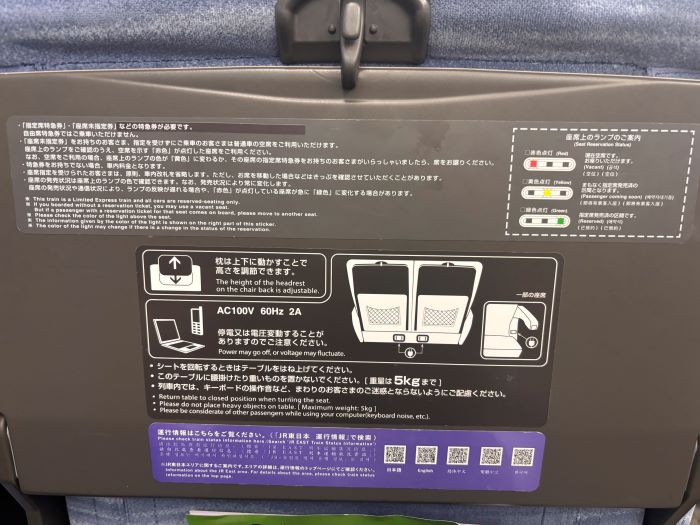
    The seat-lamp guide printed on the folding table on the back of the seat in front of you.
    The seat-lamp guide is right there on the folding table, but honestly, I still had to think about it.

    Even if nobody is sitting there, if the lamp says someone will get on at the next station, you have to move.

    Moving with your luggage is annoying, and constantly wondering, “Is it okay if I sit here?” is also tiring.

    So yes, I recommend getting a reserved seat limited express ticket.


    Things to Know About the E353 Train

    The details can change depending on which train you ride, so from here, let’s talk about the train itself.

    The Azusa is operated using a train called the E353 series.

    Here are a few things travelers may want to know about this train.

    1. Toilets

    Yes, there are toilets.

    Not every car has a toilet, but the train does have them.

    One thing to be careful about is that you cannot walk through the Green Car.

    Also, if two front cars are connected together — you know, the “head” part of the train — you cannot walk through that section either.

    But other than that, you can walk through the train, so I don’t think you need to worry too much about toilets.

    They are pretty clean too.

    And toilet paper is usually there, as long as it has not run out!

    2. Power Outlets

    There are power outlets.

    They are either in front of your seat or under the armrest.

    If you want to charge your phone or use your laptop, you can use them.

    They are standard Japanese power outlets.
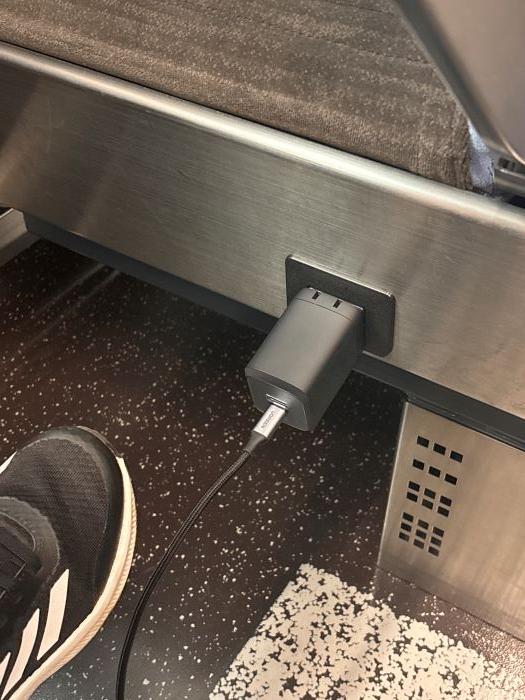
    Power outlet below the seat on the Limited Express Azusa train
    A power outlet on the Limited Express Azusa. Mine was near the floor, so it may be easy to miss.
    And yes, sorry about the little foot in the photo!

    3. Luggage Space

    Some cars have luggage space.

    But honestly, whether everyone can use it is another question. The luggage space is not that big.

    From my point of view, the seat pitch is wide enough that I could put a larger suitcase at my feet without much trouble.

    But depending on your body size, that may not work for you.

    So please do not assume that there will always be a perfect place for your suitcase.

    If you cannot find anywhere to put it, one option is to stay in the deck area with your luggage.

    Just don’t leave your luggage there by itself!

    Depending on the situation, it may be treated as suspicious luggage, and that sounds like a huge headache.

    4. Trash Bins

    There are trash bins near the doors.

    They are in the deck area, where people get on and off the train.

    They are often on one side of the wall near the train doors, so look around there.

    5. Food and Drink Service

    Food and drink service may or may not be available.

    I think it is available on some regular trains, but it may not be available on extra seasonal trains.

    So if you would be in trouble without food or drinks, bring something with you before boarding.

    The ride from Shinjuku to Matsumoto takes less than three hours, but still.

    Sometimes you just want a snack, right?


    Enjoy the Ride!

    The Azusa uses a newer train, and the ride is comfortable, so I hope you look forward to it.

    If the weather is good, you may even be able to see Mount Fuji or the Yatsugatake Mountains from the window.

    Have a great trip!
  • Arriving at Narita Airport Late at Night? I Wouldn’t Recommend It

    Okay, this is a follow-up to my previous post!

    We already talked about Narita and Haneda, right? This time, let’s focus on Narita Airport.

    Let me say my conclusion first: I don’t really recommend arriving at Narita Airport late at night.

    The reason is simple. Getting from Narita to Tokyo on the same night can be much harder than you might expect.

    If your flight arrives after 23:00, it is already pretty difficult. And honestly, even if your flight arrives after 22:00, immigration and baggage claim can take time.

    In many cases, staying at or near Narita Airport may be the more realistic option.


    Why Narita Is Different Late at Night

    In my previous article about late-night hours in Tokyo, I said that some trains still run after midnight. So why am I saying Narita is difficult?

    Let me explain.

    When I said there are trains after midnight, I was mainly talking about trains going from central Tokyo out to the suburbs.

    But from Narita Airport to Tokyo, you are going in the opposite direction. Narita Airport is far outside central Tokyo, and trains from Narita toward the city center can finish earlier than trains leaving central Tokyo for the suburbs.

    So if you think, “Tokyo has trains late at night, right?” Narita may surprise you.

    Also, Narita Airport basically has a midnight curfew. Flights after 24:00 are heavily restricted, except in emergencies or unavoidable situations.

    I remember reading an old news story about a flight being just about 20 seconds over the curfew. I couldn’t find the article again, so please take this as my memory, not an official source.

    But that is the kind of image I have of Narita’s curfew: very strict.

    Narita Airport curfew information

    This page is in Japanese, so you may need to use translation.

    If a flight cannot make it to Narita in time, it may be diverted to another airport. So this is something to be careful about.

    So let’s look at what actually happens when you try to leave Narita around midnight. This is where you’ll see why I don’t recommend it.


    What Happens If You Try to Leave Narita Around Midnight

    Narita Airport is mainly served by two train companies: Keisei Electric Railway and JR East.

    Narita Airport official train access page

    The train times I’m talking about here are based on the August 2026 timetable.

    Keisei Line

    The last Keisei train leaves at 0:09. In other words, 24:09.

    But here is the catch. This train only goes as far as Sogosando Station.

    I’ll be honest. I use Narita Airport fairly often, but I had never even heard of this station.

    So I checked it on Google Maps. And if I were dropped off there late at night, I would probably just hold my head in my hands.

    So if you want to get to central Tokyo, the more realistic options are the 22:33 train to Keisei Ueno, or the 22:55 train to Keisei Takasago, where you can transfer toward Asakusa.

    But if you don’t know the area, that is hard to understand, right?

    Here is what I want you to notice: if you arrive at Narita in the 23:00 hour, getting to central Tokyo by Keisei Line is almost impossible.

    JR East

    Now, let’s talk about JR East.

    The last JR train I found was at 23:42. It goes to Chiba Station.

    Chiba Station is a major station, and you can find hotels there. It has the same name as Chiba Prefecture, where Narita Airport is located.

    But it is not Tokyo.

    If you have something you want to do in Chiba, that may be fine. But if your plan is Tokyo, it feels a little awkward.

    And yes, Tokyo Disneyland is also in Chiba Prefecture. But it is almost next to Tokyo, so it is still far from Narita.

    In other words, even with JR East, getting to Tokyo late at night is difficult.

    Airport Limousine Bus

    I also checked the Airport Limousine Bus. For Tokyo Station, the last bus I found was at 22:45.

    There may be late-night budget buses that are not listed on the Narita Airport website, kind of like LCCs for flights. But there are many options, and I couldn’t check every single one. Sorry!


    So, What Should You Do?

    Narita Airport is far from Tokyo, and the last trains toward central Tokyo leave earlier than many travelers might expect.

    So if you arrive after 23:00 — or honestly, even after 22:00 once you think about immigration and baggage claim — staying at or near Narita Airport may be the more realistic choice.

    If you still have enough energy, renting a car may be another option.

    And if you have the budget, you could also take a taxi from Narita. It looks like a taxi to Tokyo Station can cost around 30,000 yen!

    Nihon Kotsu fixed-fare taxi information

    This page is in Japanese, so you may need to use translation.

    If you really get stuck, some facilities inside Narita Airport are open 24 hours, so please check the official website.

    Narita Airport early morning and late-night information

  • Things to Know Before Riding the Limited Express Shinano

    This article is not about Tokyo, but I actually rode this train myself, so I wanted to share a few things I noticed.

    I rode the Limited Express Shinano in August 2026.

    There were a few things I thought:

    “I’m glad I know this now, but I wish I had known it before boarding.”

    So let me share them with you.

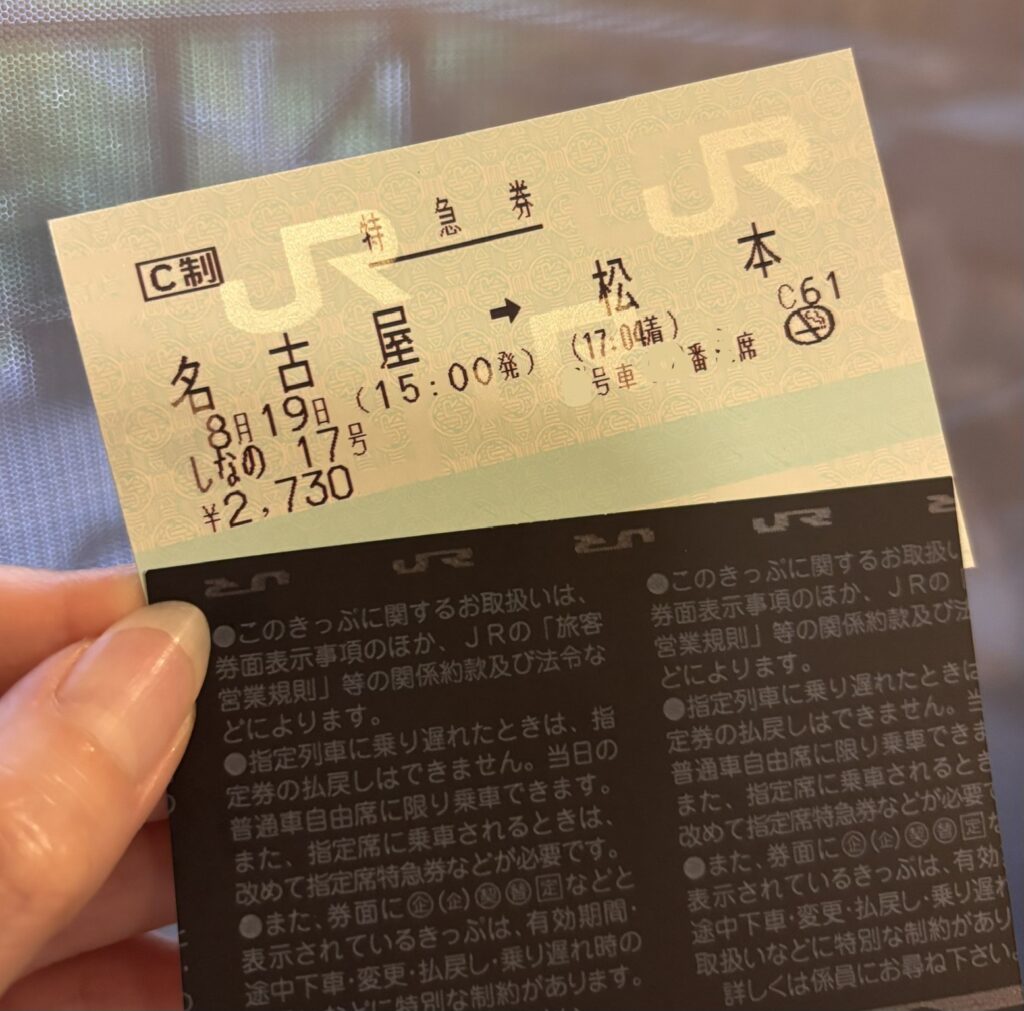
    Limited Express Shinano ticket in August 2026
    My ticket for the Limited Express Shinano in August 2026.

    The Limited Express Shinano is a limited express train that runs between Nagano Station in Nagano Prefecture and Nagoya Station in Aichi Prefecture.

    It can be useful if you want to visit places like Zenko-ji Temple or Matsumoto Castle in Nagano, enjoy retro Japanese scenery around areas like Magome-juku, or continue on to Nagoya for Nagoya Castle and local food.

    The ride from Nagano to Nagoya takes about three hours.

    That is long enough that a little preparation can make your trip much more comfortable.


    Reserved Seats Are Safer If You Can Get One

    The Limited Express Shinano usually has reserved seats and some non-reserved seats.

    If you can book a reserved seat, it is much easier.

    You can simply arrive at the station in time for your train and know that your seat is already secured.

    I especially recommend a reserved seat if you have large luggage or if you are riding for a long section, such as between Nagano and Nagoya.

    One thing to keep in mind: non-reserved seats may not be available in some seasons, and the train may operate as reserved seats only.

    Please check before your trip.


    1. Don’t Expect to Charge Your Phone on Board

    This was the thing that surprised me the most.

    When I rode the Limited Express Shinano in August 2026, I could not find any power outlets or USB ports around my seat.

    If you are used to newer Shinkansen trains or newer limited express trains, you might think:

    “Well, I can probably charge my phone somewhere.”

    But on the Shinano, I recommend assuming that you cannot charge your phone on board.

    The ride from Nagano to Nagoya takes about three hours.

    If you use your phone for maps, photos, translation apps, or checking your next route, the battery can drain faster than you expect.

    I really recommend bringing a portable charger.

    Please do not underestimate this one.


    2. The Toilet in Car No. 3 Was a Japanese-Style Squat Toilet

    There are toilets on the Limited Express Shinano.

    When I rode it, there were toilets in car No. 1, car No. 3, and car No. 5.

    But here is the important part.

    When I rode the Shinano in August 2026, the toilet in car No. 3 was a Japanese-style squat toilet.

    You may have seen squat toilets in other countries too, but if you are not used to the Japanese-style version, this one may feel a little unfamiliar.

    Also, the Shinano can sway quite a bit, so please don’t feel like you have to try it just for the experience.

    If you are not comfortable using it, I recommend using the toilets in car No. 1 or car No. 5 instead.

    Even if your seat is in car No. 3, you can walk to car No. 1 or car No. 5 when you need to use the toilet.

    Just be careful when moving between cars, because the train can sway while you walk.

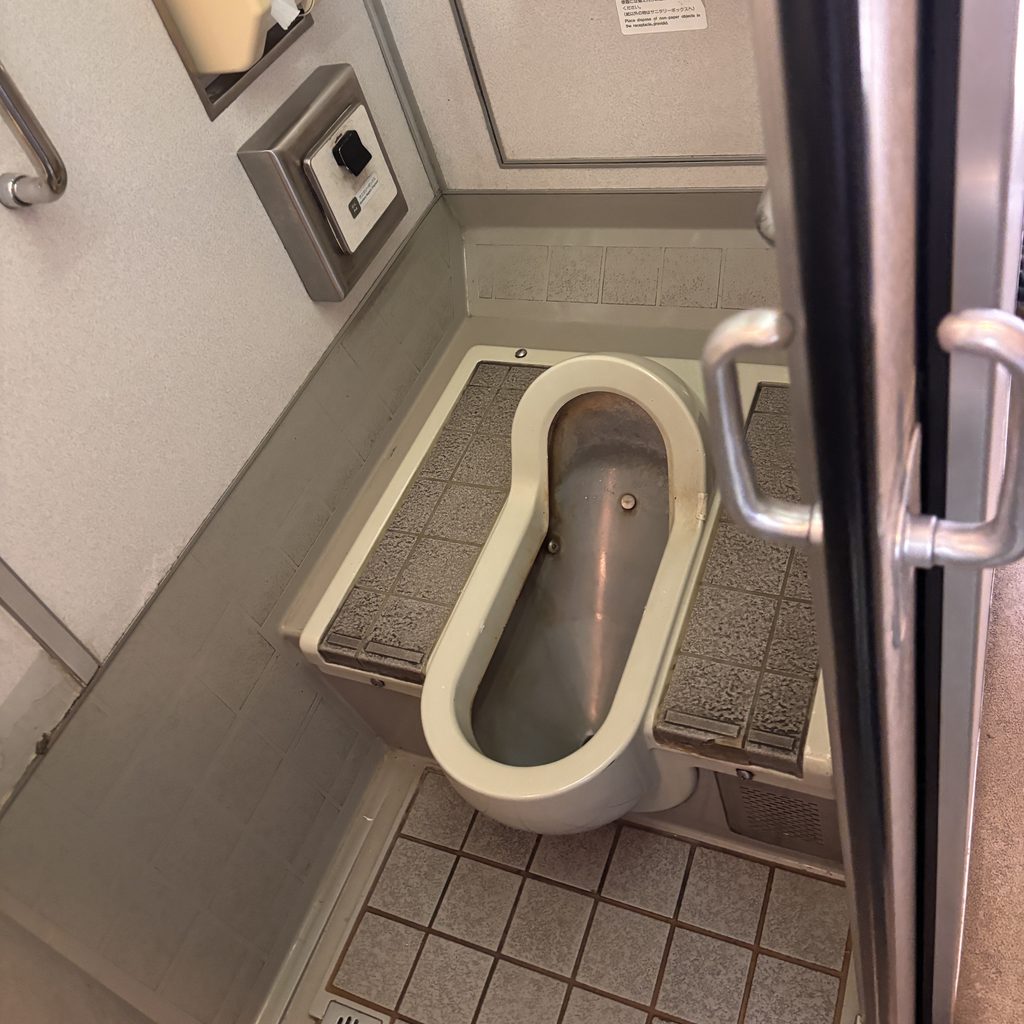
    Japanese-style squat toilet in car No. 3 on the Limited Express Shinano
    The toilet in car No. 3 was a Japanese-style squat toilet when I rode the Shinano in August 2026.

    If you look at the photo, you can clearly see what a Japanese-style squat toilet looks like.

    If you are not comfortable with this type of toilet, please do not force yourself to use it.

    Just go to another car.


    3. Don’t Count on Buying Food or Drinks on Board

    Another important thing is food and drinks.

    When I rode the Shinano, there was no food or drink service on board.

    The ride from Nagano to Nagoya takes about three hours.

    If you board without anything, it might feel a little tough.

    I recommend buying a drink before you get on the train.

    If you think you might get hungry, it is also a good idea to buy something light, like rice balls, bread, or snacks, at the station.

    Especially in summer, I really think you should buy at least a drink before boarding.


    A Little Preparation Makes the Ride Much Easier

    To sum it up, here are the main things to know before riding the Limited Express Shinano:

    • Bring a portable charger, because you may not be able to charge your phone on board.
    • If you are not comfortable with Japanese-style squat toilets, use the toilet in car No. 1 or car No. 5.
    • Buy drinks and light food before boarding.
    • Check before your trip whether non-reserved seats are available.

    The Limited Express Shinano is a convenient train for traveling between Nagano and the Nagoya area.

    You can enjoy the scenery along the way, and it can be a useful route for sightseeing.

    But if you ride it with the same expectations as a newer Shinkansen train, you might be a little surprised.

    Just knowing these things before boarding can make the ride much more comfortable.

    Enjoy your trip!

  • Japan Uses the 24-Hour Clock More Than You Might Expect

    I once read an interesting article somewhere.

    It said something like:

    “Japanese people can instantly understand that 17:00 means 5 p.m.? What is this, the military?!”

    Wait, wait, wait.

    In Japan, the 24-hour clock is pretty normal from quite a young age!

    You’ll see it not only on train and bus schedules, but also for reservation times, opening hours, work emails, and casual messages about meeting up.

    For example, if someone says:

    “Let’s meet at Shinjuku West Exit at 13:00!”

    Most Japanese people will naturally understand it as 1:00 p.m.

    Of course, we also say “1 p.m.”

    But honestly, using just the numbers is often easier, both when writing and speaking.

    In Japan, children learn how to read clocks from a young age.

    At first, they learn to read the clock as it is: “1 o’clock,” “2 o’clock,” and so on.

    Then, after learning addition and subtraction, they gradually learn the 24-hour clock too.

    By around age eight, many children start to understand things like:

    “13:00 means 1 p.m.”

    “17:00 means 5 p.m.”

    The idea slowly becomes familiar.

    One reason you see the 24-hour clock so often in Japan is probably public transportation.

    Train and bus schedules usually use the 24-hour clock.

    When you’re traveling and looking at a timetable at a station or bus stop, you’ll often see times like 13:00, 18:30, or 23:15.

    If you’re not used to it, it might take you a second.

    And when you’re traveling, that one second can feel surprisingly stressful.

    So today, while getting used to the 24-hour clock, let me walk you through what a typical day in Japan feels like.

    This is mostly based on Tokyo and other big cities.

    Smaller towns and tourist areas may feel a little different.


    What a Day in Japan Feels Like

    5:00

    Early morning.

    People who start their day very early may already be moving around by this time.

    But most places open at this hour are 24-hour convenience stores or a few restaurants.

    6:00

    People who are going to work start waking up little by little.

    Stations and streets slowly begin to come alive.

    7:00

    Trains start getting crowded with commuters.

    Highways also begin to get busy around this time.

    If you’re taking a highway bus, it may be delayed because of traffic.

    People may imagine Japanese public transportation as very punctual, but highway buses run on roads. Once they get stuck in traffic, there’s only so much they can do.

    Some cafés and chain restaurants that serve breakfast also start opening around this time.

    8:00

    Schools begin around this time too.

    More students are on their way to school, so stations and streets get even busier.

    9:00

    Street-level shops and public facilities gradually start opening.

    Banks and city offices often start around this time too.

    10:00

    Station buildings, department stores, and large shopping facilities begin to open.

    If you want to start sightseeing or shopping, this is around the time when it becomes easier to move around.

    12:00–14:00

    This is what many Japanese people think of as “lunchtime.”

    If you go to a restaurant during this time, it may be quite crowded.

    On weekdays, some restaurants offer special lunch menus, which are often a good deal.

    Be especially careful around office areas and near major stations.

    15:00

    Snack time.

    This is the kind of time when you start wanting to sit down at a café.

    On the other hand, bank counters often start closing around this time.

    Many ATMs can be used at night, but it depends on the location and the bank, so be careful.

    If you’re in trouble, try checking a convenience store.

    Most major convenience stores have ATMs.

    17:00

    Public facilities and tourist facilities start closing.

    Museums, small local museums, city offices, and similar places often close around this time, so be careful.

    If you think, “I’ll just go in the evening,” it may already be closed.

    It’s honestly so sad when you go all the way there and the place isn’t open.

    I’ve done that abroad too.

    18:00

    More people finish work, and trains start getting crowded again.

    Before COVID, some trains were so crowded that there was barely any room to stand.

    These days, with remote work and other changes, some places seem a little calmer than before.

    This is also around the time when many Japanese people start having dinner.

    Restaurants can get crowded too.

    21:00

    The evening rush starts to calm down a little.

    Regular shops begin closing.

    On the other hand, people going out for drinks may start moving around this time.

    23:00

    This is when people start thinking about the last train.

    At this hour, you should assume that regular tourist facilities and shops are already closed.

    Of course, in nightlife areas, some izakaya and bars stay open late.

    But it really depends on the area.

    This is also around the time when more people start getting ready for bed.

    24:00

    The date changes.

    For train schedules, this is often written as 0:00, but in Japan, you may also see “24:00.”

    Trains gradually reach their last departures around this time.

    25:00

    By this point, most trains are already finished for the night.

    On train schedules, this would be 1:00.

    But in restaurant information, TV programs, event listings, and similar places, you may sometimes see “25:00.”

    It means 1 a.m.

    It’s like treating the time after midnight as an extension of the same day.


    So, that’s the general idea!

    What do you think?

    Is it different from your country?

    When I stayed with a host family in Canada, the father left for work around 5 a.m.

    So I think the idea of “early morning” or “late night” can feel quite different depending on the country, or even the family.

    It might feel confusing at first, but knowing this sense of time can be really helpful when traveling in Japan.

    “Oh, it’s lunchtime, so restaurants will be crowded.”

    “The commute has started, so trains will be busy.”

    “It’s after 17:00, so some tourist facilities may already be closing.”

    You can start to read the day a little better.

    And if you arrive in Japan very early in the morning or late at night, you need to be even more careful.

    Trains, shops, cafés, and buses may not be moving the way you expect.

    In the next article, I’ll talk more specifically about arriving at the airport early in the morning or late at night.

    This is one of those things that can really cause trouble if you don’t think about it ahead of time.

  • Tourist IC Card or Regular IC Card: Which Should You Get in Japan?

    In my last post, I talked about how useful IC cards are in Japan. But when you’re actually planning a trip, it can be hard to decide what to do.

    1. Get a tourist IC card
    2. Get a regular IC card
    3. Don’t get one

    Let’s rule out option 3 for now. You probably saw that coming.

    Being able to buy an IC card once and stop worrying about train tickets is a huge advantage.

    Buying tickets during a trip can be surprisingly stressful. You need to find the ticket machine, figure out the correct fare, and use coins you’re not familiar with… and all of this while trying not to hold up the line.

    I would choose option 2 — a regular Suica or PASMO, not a tourist version.

    It’s true that these cards are only sold at certain stations, but honestly, finding a station that doesn’t sell them might be the rare part. Getting one is usually very easy.

    I’d probably keep it as a souvenir. And maybe as a little good-luck charm too — hoping I can come back to Japan again within the next 10 years.


    Before we figure out which option is best for you, let me explain a couple of words.

    A deposit is a refundable fee you pay when the card is issued. In Japan, it’s 500 yen. For comparison, that’s about the price of three or four 500ml bottles of water.

    You’ll also hear the word ”charge”. In Japan, that’s what we call adding money to a prepaid card.

    With that in mind, let’s see which option fits you best.


    Tourist IC Cards Might Be Best For You If…

    • You absolutely don’t want to pay a deposit.
    • You’re staying in Japan for 28 days or less.
    • You’re confident you won’t forget to buy one at the airport.
    • You’d like to keep the card as a souvenir.
    • You’re comfortable keeping an eye on your balance and using it all before you leave.

    A Regular Suica or PASMO Might Be Better If…

    • You’re okay with potentially leaving the deposit behind if you decide not to claim it back.
    • You want the option to refund both the deposit and any unused balance.
    • You’re staying in Japan for more than 28 days.
    • There’s a chance you’ll come back to Japan within the next 10 years.

    How about you?

    Can you decide which one sounds better for your trip?


    A Few Things to Keep in Mind

    If You Choose a Tourist IC Card

    • I strongly recommend buying it at the airport if possible. There aren’t many sales locations, and even from the perspective of someone who lives in Japan, some of them are a little inconvenient.
    • There’s no deposit, but any money left on the card cannot be refunded. Make sure you use up the balance before you leave Japan.
    • If only a small amount remains, some stores allow you to combine IC card payment with cash.
    • Convenience stores can usually do this, but it’s always best to ask first.
    • You can try asking: “IC card and cash, OK?” Funny enough, simple keywords often work better than full English sentences in Japan.

    If You Choose a Regular IC Card

    • A deposit is required, but if you request a refund, both the deposit and any remaining balance can be returned.
    • Once you get a refund, you’ll need to hand the card back, so a tourist card may be better if you want to keep it as a souvenir.
    • Using the card even once within 10 years resets the expiration period.
    • But if more than 10 years pass without any use, there’s no way to reactivate it, so don’t forget about it!

    One more thing: a fee may apply when refunding the remaining balance. It’s roughly the price of a bottle of water.

    If you don’t want to pay even that, just stop by a convenience store before you leave and spend the remaining balance on snacks. Not a bad ending, right?


    If you’d like the official details about tourist IC cards, you can find them here:

    Welcome Suica

    https://www.jreast.co.jp/en/multi/welcomesuica/welcomesuica.html

    TOURIST PASMO

    https://www.pasmo.co.jp/tourist-pasmo

  • Think IC Cards Are Only for Trains? Think Again.

    In Japan, we always call them “transportation IC cards.”

    They are incredibly useful.

    If you’ve been to Hong Kong, they’re similar to the Octopus Card.

    If you’ve been to Singapore, think of something like EZ-Link.

    In Tokyo, the most common ones are Suica and PASMO.

    Some visitors may think IC cards are mainly for trains and buses.

    But honestly?

    In Tokyo, you can get through most of your day with just an IC card.

    Since this is Notes From Tokyo, let’s take a little Tokyo day trip together.


    Imagine this.

    You check out of your hotel in the morning.

    You grab breakfast at a convenience store or stop by a café.

    You leave your luggage in a locker and hop on a train.

    How about visiting Senso-ji Temple in Asakusa?

    Maybe you get a little hungry and buy some street food.

    Or maybe you pick up a few souvenirs.

    Feeling thirsty?

    Don’t worry.

    There is probably a vending machine nearby.

    Vending machines are everywhere in Japan.

    After lunch, it’s time to hop on another train.

    You can’t leave Tokyo without visiting Shibuya, right?

    If you have extra time, Meiji Shrine is a great choice too.

    And of course, don’t miss the famous Scramble Crossing.

    Hungry again?

    No problem.

    Shibuya has plenty of places to eat.

    After dinner, maybe you want to enjoy the city lights.

    Wait…

    Did you get a small cut while exploring?

    Let’s grab a first-aid kit from a drugstore.

    Now you’re tired.

    You’ve been walking all day.

    Take the train back, pick up your luggage from the locker, and head to your next hotel.

    Sounds fun, doesn’t it?


    Well, here’s the best part.

    Almost everything I just described can be paid for with an IC card.

    Pretty amazing, right?

    To be honest, I personally carry cash and credit cards mostly as a backup.

    They only come out when I really need them. 😄


    Of course, not every place accepts IC cards.

    Shrines and temples sometimes require cash.

    Older shops and older facilities may not accept IC cards either.

    That’s why I recommend carrying a small amount of Japanese yen and a credit card, just in case.

    And if there’s a place you absolutely want to visit, check the payment methods beforehand.

    Not sure?

    Feel free to leave a comment.

    If it’s something I can check, I’ll do my best to help.

    So, did I convince you?

    Transportation IC cards are one of the most useful things you can have while visiting Japan.

    They’re easy to use, convenient, and very traveler-friendly.

    Definitely keep them in mind for your trip!

  • Tokyo Has Two Airports — Don’t Mix Them Up

    Welcome to Tokyo!

    If you’re coming to Tokyo, there’s one thing I really want you to remember.

    The Tokyo area has two major international airports.


    1. Narita International Airport (NRT)

    Narita International Airport’s airport code is NRT.

    It has many international flights, so even people who live in Tokyo often use it.

    But here’s the thing.

    Narita Airport is not actually in Tokyo.
    It’s located in Chiba Prefecture, right next to Tokyo.

    That means getting there can take quite a bit of time.


    2. Tokyo International Airport (HND)

    Tokyo International Airport’s airport code is HND.

    This airport is actually located in Tokyo.

    And here’s something worth remembering.

    Most Japanese people don’t usually call it “Tokyo International Airport.”

    They call it Haneda Airport.

    The official name is “Tokyo International Airport,” but almost everyone in Japan says “Haneda Airport.”

    Even the official website uses “haneda” in its domain:

    https://tokyo-haneda.com/index.html

    Not “Haneda International Airport.”
    Just Haneda Airport.

    That’s the name people in Japan will understand.

    The name “Tokyo International Airport” is so rarely used that it can actually sound unfamiliar to many Japanese people.

    So if you need to ask for directions, don’t say:

    “I want to go to Tokyo International Airport.”

    It’s much more natural to say:

    “I want to go to Haneda Airport.”


    Do I only need to remember my own airport?

    You might think so.

    I get it.

    But please make sure you know which airport you’re using.

    Because Haneda — remember that name now? — and Narita are far apart.

    Traveling between them usually takes around 1.5 to 2 hours.

    I actually saw this on a Japanese TV program.

    Apparently, some visitors accidentally go to the wrong airport.

    If that happens when you arrive in Japan, it’s usually not a disaster.
    You can stop, figure out where you are, and continue your trip.

    The real problem is when you’re leaving Japan.

    Some travelers go to the wrong airport and miss their flight.

    That would be a terrible way to end a trip.

    I hope your visit to Japan is smooth, fun, and full of great memories!